



Clinical Guide · 2025
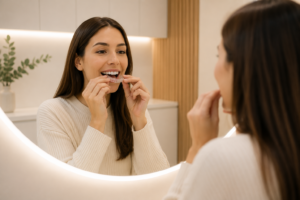
Real differences, indicated cases, prices, and everything you need to know before choosing, explained by our dentists in Benalmádena.
Choosing between invisible orthodontics or braces is one of the most frequent questions in consultations. Both options correct teeth, but they work in very different ways and have specific indications. As experts in orthodontics in Benalmádena, we explain everything with clinical criteria and without beating around the bush.
What is invisible orthodontics?
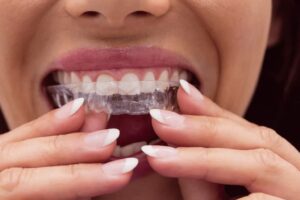
Invisible orthodontics, also known as aligner orthodontics, uses a series of transparent, custom-made plastic splints that are placed over the teeth and gradually move them. The best-known system is Invisalign, although there are other brands such as Spark or Angel Aligner.
How does it work in practice?
What are braces?
Conventional braces are the classic fixed orthodontic system: metal or ceramic pieces glued to the surface of the teeth and connected by an archwire. The patient does not remove them during treatment; only the orthodontist can do so in the clinic.
Most common types of braces
| Type | Material | Aesthetics | Relative Cost |
|---|---|---|---|
| Metal | Stainless steel | Visible | Low |
| Ceramic | Ceramic or sapphire | Discreet | Medium |
| Sapphire | Polycrystalline sapphire | Very discreet | Medium-High |
| Lingual | Metal (inner surface) | Invisible from outside | High |
Full comparison: invisible orthodontics vs braces
- ✓Practically invisible during the day
- ✓Removed for eating: no dietary restrictions
- ✓Complete and easy dental hygiene
- ✓No rubbing or ulceration of the mucosa
- ✓Check-ups every 6–8 weeks
- —Requires high discipline of use (22h/day)
- ✓Fixed: result does not depend on discipline
- ✓Indicated for complex and severe cases
- ✓Greater biomechanical control of movement
- ✓Most economical option in metal variant
- ✓Ideal for children and adolescents
- —Restrictions with hard or sticky foods
| Feature | Invisible Aligners | Braces |
|---|---|---|
| Aesthetics | Practically invisible | Visible (except lingual) |
| Comfort | No rubbing or sharp edges | Initial adaptation |
| Eating | No restrictions | Avoid hard and sticky foods |
| Dental hygiene | Easy (removed) | Requires more technique |
| Discipline | High (22h/day mandatory) | Low (they are fixed) |
| Complex cases | Mild-moderate and selected | From mild to severe |
| Average duration | 12–24 months | 18–36 months |
| Average price Spain | €2,500–€5,500 | €1,500–€4,000 |
Indicative prices. Vary according to the system, case complexity, and clinic. The only reliable quote is the one you receive after a real examination by the specialist.
When is invisible orthodontics recommended?
Aligners are especially suitable when these circumstances apply:
- You want total discretion: you work with the public or do not want the treatment to be noticeable.
- You have mild or moderate malocclusion: diastemas, mild crowding, simple crossbite, or minor rotations.
- You value comfort and convenience: no metal edges and generally faster adaptation.
- You play contact sports: by being able to remove them, the risk of mucosal injuries is much lower.
- They are not the best option if you require multiple extractions, skeletal corrections, or if you know you will not adhere to the wearing hours.
When are braces recommended?
- The complexity is high: severe crowding, very open or deep bites, necessary extractions.
- The patient is a child or adolescent: lack of discipline for 22 hours a day can compromise the result with aligners.
- The greatest biomechanical control is needed: in complex cases, the orthodontist manages each movement with greater precision.
- The budget is tighter: metal braces are the most economically accessible option.
The best orthodontics is not the most expensive or the most discreet. It is the one that is well indicated for your case and directed by a qualified specialist.
Frequently Asked Questions
How to make the right decision?
The honest answer is that you cannot decide alone, but you can come to the consultation well-informed. These are the factors we consider at AllDent:
What the specialist evaluates
- Complete clinical and radiological diagnosis
- Degree of malocclusion (Angle’s classification)
- Need for dental extractions or not
- Patient’s age and bone development
- Current oral hygiene status
What you should communicate
- Your priority: aesthetics, economy, or comfort
- Your actual level of discipline and daily routine
- If you play contact sports
- Your available or maximum budget
- If you have a deadline (wedding, event…)